Pakistani diet plan for weight loss: free chart and how to start
A diet plan for weight loss works best in Pakistan when it keeps home food (roti, daal, sabzi, salan) and changes the portions, the cooking oil and the sugar. Aim to lose about ½ to 1 kg a week. Below is a sample one-day chart, the swaps that matter most, and a BMI check.
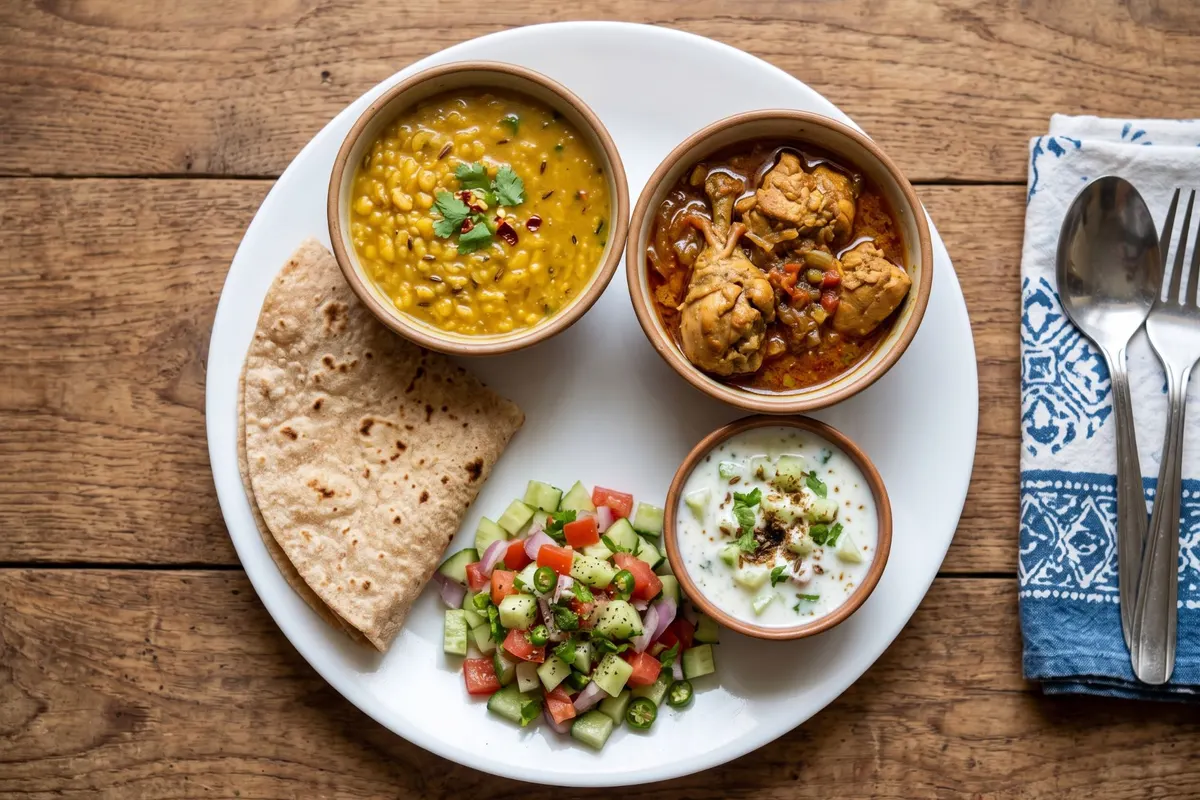
7 rules of a Pakistani weight loss diet
- Eat a little less than your body uses. Weight loss needs a calorie deficit. You get there with smaller portions of the same food, not with special foods.
- Fill half the plate with sabzi or salad. Vegetables add volume and fibre for very few calories, so you feel full on less.
- Have protein at every meal. Daal, chanay, eggs, chicken, fish or dahi keep you full longer and protect muscle while you lose fat.
- Count your rotis. Decide the number before you start eating. Rice counts the same way: about ½ plate.
- Measure oil and ghee. In most Pakistani homes, cooking fat is the largest hidden source of calories.
- Take sugar out of drinks first. Chai sugar, cold drinks and packaged juices add calories without filling you.
- Walk daily and sleep enough. A 30-minute walk and 7–8 hours of sleep make the diet easier to follow.
Calorie deficit in simple words
Weight loss happens when you eat fewer calories than you use. A gap of about 500 to 600 kcal a day usually gives around ½ kg of loss per week, which is within the 0.5 to 1 kg a week the NHS calls safe. In food, you usually need several small changes together: for example, one chapati less (about 100 kcal), a tablespoon less cooking oil (about 120 kcal), no sugar in three cups of chai (about 100 kcal) and no cold drink (about 100 kcal). Pick swaps you can keep, instead of cutting whole meals.
Very low-calorie plans are for medical supervision only. If your target would fall below 1,200 kcal (women) or 1,500 kcal (men), talk to a dietitian first.
To count your deficit at home, start with the foods you eat most: the calories in roti, naan and paratha guide lists desi staples per piece.
How much should you eat? Calories and roti count
| Who | Calories a day | Roughly |
|---|---|---|
| Most women | 1,200 to 1,500 kcal | 3 to 4 chapatis (or rice in their place) |
| Most men | 1,500 to 1,800 kcal | 4 to 5 chapatis |
| Very active, tall or heavy adults | Often more; use the calculator | Set by a dietitian |
These ranges come from the American heart and obesity guideline and suit most adults; your own number depends on weight, height, age and activity. Work it out with the calorie calculator, and if you want exact menus at a set number, see the 1200 and 1500 calorie plans.
Protein at every meal: how much is enough?
For most adults losing weight, a palm-sized portion of protein at each meal is a good start: 1 egg or 2 egg whites with nashta, 1 katori daal or chana at lunch, a piece of chicken or fish (about 80 to 100 g cooked) at dinner, and dahi or roasted chanay as a snack. Protein keeps you full and helps keep muscle while you lose fat. People with kidney disease must not raise protein without their doctor.
Which weight loss plan fits you?
This page is the general plan. These pages go deeper for a specific situation, so you do not have to mix advice.
| If you want | Read |
|---|---|
| A full week of meals | 7-day weight loss diet plan |
| A plan for women (iron, periods, PCOS) | Weight loss diet plan for women |
| A plan for men (roti count, belly fat) | Fat loss diet chart for men |
| To lose weight after a baby | Weight loss after pregnancy |
| Exact calories (1200, 1500) | 1200 and 1500 calorie diet plans |
| To know if "10 kg in 7 days" is safe | Is fast weight loss safe? |
| To lose weight while fasting | Ramadan diet plan |
| Weight loss with PCOS or thyroid | PCOS diet plan or thyroid diet chart |
| A low-carb approach | Keto diet in Pakistan |
| The same plan in Urdu | وزن کم کرنے کا ڈائٹ پلان |
Shortcuts people ask about: apple cider vinegar and green tea give at most a small effect and do not replace a calorie deficit. Prescription injections are covered in what to eat on weight-loss injections.
Sample one-day weight loss diet chart
| On waking | 1–2 glasses of water. Tea or coffee without sugar if you like | |
|---|---|---|
| Nashta · 8:00 | 1 chapati or 2 slices brown bread, 1 boiled egg or 1 katori chana, chai with little or no sugar | protein |
| Mid-morning | 1 fruit: amrood, seb, kinnow, papita or a slice of melon | fibre |
| Dopahar · 1:30 | ½ plate salad or sabzi, 1 katori daal or chicken salan, 1 chapati | half plate veg |
| Shaam ki chai | Chai with little sugar + a handful of roasted chanay or 1 katori dahi | no biscuits |
| Raat · 8:00 | 1 katori sabzi, ½ katori daal or a piece of fish or chicken, raita, 1 small chapati | 2–3 h before sleep |
Pakistani food swaps for weight loss
Small changes to everyday food, without a separate menu.
| Instead of | Try |
|---|---|
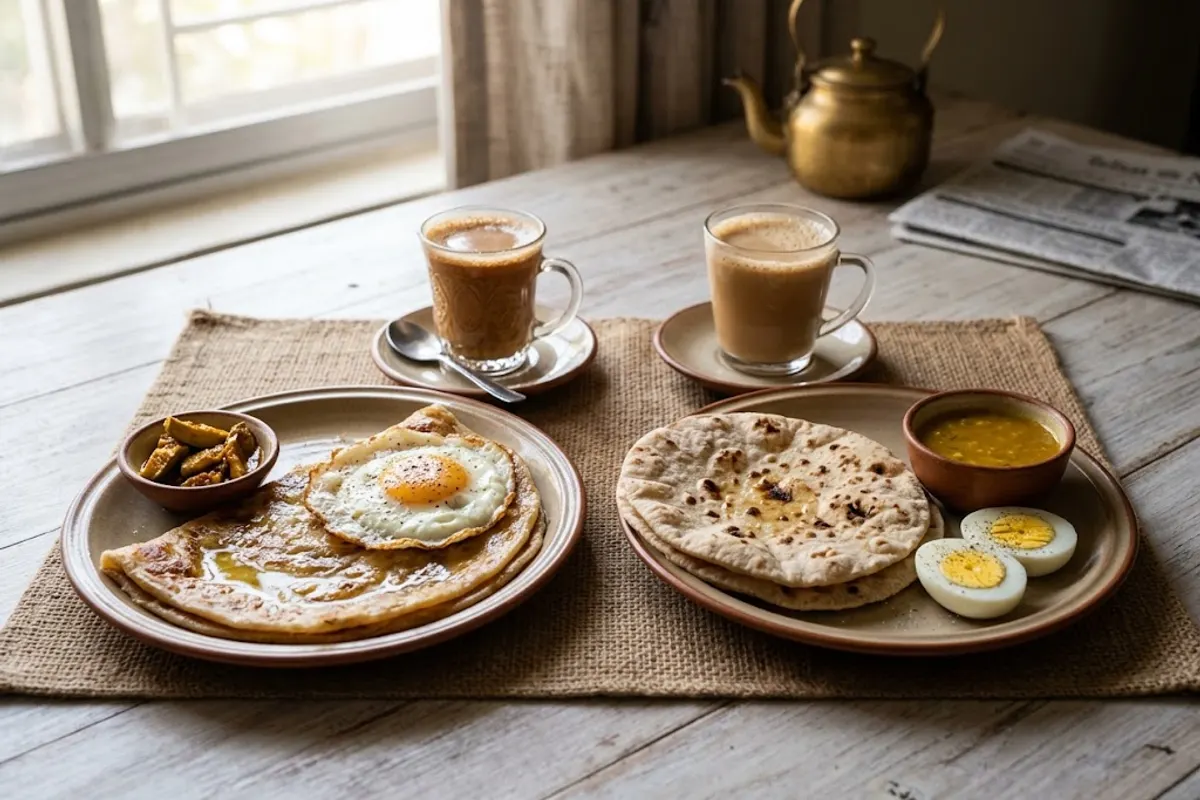
| Paratha | Chapati (dry, no ghee on top) |
| Fried egg or omelette in oil | Boiled or poached egg |
| Chai with 2–3 spoons sugar | Chai with ½ spoon, then none |
| Cold drink, packaged juice | Water, lemon water without sugar, lassi without sugar |
| Samosa, pakora, nimko | Roasted chanay, popcorn without butter, fruit |
| Biryani or pulao as a full plate | ½ plate rice with extra raita and salad |
| Oil poured from the bottle | Oil measured with a spoon while cooking |
How to start: a 4-week plan
Changing everything on day one is why most diets stop by week two. Add one habit a week and keep the earlier ones.
| Week | Focus | What to do |
|---|---|---|
| Week 1 | Drinks | Sugar out of chai step by step, no cold drinks or packaged juice, 8 glasses of water. |
| Week 2 | Oil and roti | Measure cooking oil with a spoon; decide your roti count before each meal. |
| Week 3 | Protein and plate | Protein at every meal and half the plate sabzi or salad; a 30-minute walk daily. |
| Week 4 | Check and adjust | Weigh once a week, same day and time, and measure your waist. Keep what worked; fix the one habit that slipped. |
Want every meal planned for you? Follow the 7-day weight loss menu during week 3 and repeat it.
Shaadi, Eid and eating out
- At a shaadi: take salad and raita first, then one plate: a piece of chicken or a katori of qorma, ½ plate rice or 1 naan, and skip the second round. One small katori of dessert, not three.
- At a restaurant: tikka, seekh kebab, grilled fish or daal with salad and one roti beat karahi in ghee, nihari or anything fried.
- On Eid: eat normal meals at normal times; a small serving of sheer khurma is fine, the grazing all day is what adds up.
- The day after: go back to your usual chart. One heavy meal does not undo a week; giving up afterwards does.
How much weight can you lose safely?
For most adults, a safe and realistic rate is about ½ to 1 kg per week. In the first week the scale often drops faster because the body loses water; after that the loss slows down. That is normal.
Plans that promise 10 kg in 7 days mostly remove water and muscle, and the weight returns. Read whether fast weight loss is safe before trying one.
Check your BMI
Uses the Asian BMI ranges, which are lower than the Western ones because health risks start at a lower weight in South Asians.
BMI is a screening number, not a diagnosis. It does not separate muscle from fat, and it is not used in pregnancy.
Send my BMI to a dietitianTalk to a dietitian first if
- You are pregnant or breastfeeding
- You have diabetes and take insulin or sugar tablets
- You have kidney disease, liver disease or heart failure
- You are under 18 or over 65
- You have, or have had, an eating disorder
In these cases a general chart can be wrong for you. Book an online consultation.
Weight loss diet: common questions
What is the best diet for weight loss?
No single diet is best for everyone. Reviews of long trials find that low-fat, low-carb and Mediterranean-style diets give similar weight loss when calories are the same; the best one is the one you can follow for a year. For most Pakistani families that means the same home food in smaller, balanced portions.
What is a calorie deficit diet?
It means eating fewer calories than your body uses. A deficit of about 500 to 600 kcal a day usually gives roughly ½ kg of weight loss a week. These numbers are estimates; the scale also moves with water. Do not go below 1,200 kcal (women) or 1,500 kcal (men) without a doctor or dietitian.
Is there a diet chart for weight loss in Urdu?
Yes. See the Urdu page "وزن کم کرنے کی ڈائٹ" for the same chart in Urdu. The Roman Urdu names on this page (roti, daal, sabzi, katori) make it easy to follow either way.
Can I eat rice while losing weight?
Yes. Rice and roti give similar energy for the same amount. Keep rice to about half a plate, fill the other half with salad or sabzi, and add daal, chicken or dahi for protein. What matters is the total portion, not cutting rice completely.
How many rotis can I eat in a day?
Most adults losing weight do well with 3 to 4 medium chapatis a day in total, spread across meals. The right number depends on your weight, height, activity and any medical condition, which is what a dietitian works out for you.
Is chai allowed on a weight loss diet?
Yes. Two cups a day are fine for most people. The sugar is the problem, not the tea. Reduce sugar slowly, half a spoon at a time, and avoid biscuits or rusks with chai.
How fast can I lose weight safely?
About half a kilo to one kilo a week is a safe, realistic rate for most adults. Faster loss is mostly water and muscle, and the weight usually comes back.
Do I need to stop desi ghee completely?
No, but measure it. Ghee and oil are the biggest hidden source of calories in Pakistani cooking. Measuring with a spoon instead of pouring is often the single most useful change.
What is the best diet plan for weight loss in Pakistan?
The best plan is one you can follow every day with the food your family already cooks: measured roti or rice, daal or chicken for protein, half a plate of sabzi or salad, and very little sugar and oil. Crash diets give quick water loss and the weight returns. A healthy diet plan for weight loss loses about ½ to 1 kg a week.
Is a Pakistani diet plan different from an Indian diet plan for weight loss?
The rules are the same: fewer calories, more protein and vegetables, less sugar and oil. The foods differ a little. Pakistani home food has more meat, salan and paratha, so the biggest changes are usually cooking oil, the number of rotis and sugary chai. This chart is built on Pakistani meals.
Pait kam karne ka tarika kya hai?
Sirf pait ki charbi alag se kam nahi hoti; poore jism ki charbi kam hone se pait bhi kam hota hai. Is ke liye: roti gin kar khayein, chai aur cold drink se cheeni nikalein, tel naap kar dalein, har khane mein protein aur aadhi plate sabzi rakhein, rozana 30 minute walk aur hafte mein 2 din exercise. Kamar ka naap bhi naapein: Pakistani mardon mein 90 cm aur auraton mein 80 cm se zyada khatray ki nishani hai.
My weight is stuck. What should I do?
A pause of 1 to 2 weeks is normal, often from water. If the scale and your waist have not moved for 3 weeks, check the hidden extras first: oil in salan, sugar in chai, weekend eating out and late-night snacks. Then cut one chapati a day or add 15 minutes to your walk. Do not jump to skipping meals.
Is this a free diet plan?
Yes. The chart on this page is free to follow. It is a general example; a personal plan from a dietitian adjusts portions to your weight, routine, reports and medicines.
Want a plan made for your body?
Send your weight, height, reports and goal on WhatsApp. A qualified dietitian makes your personal chart and adjusts it at follow-ups.
Sources
- Ge L et al. Comparative effectiveness of 12 dietary approaches on weight and cardiometabolic risk factors: a network meta-analysis. BMJ, 2020
- WHO Expert Consultation. Appropriate body-mass index for Asian populations. The Lancet, 2004
- World Health Organization. Healthy diet: fact sheet
- NHS. Lose weight: Better Health
- Jensen MD et al. 2013 AHA/ACC/TOS Guideline for the Management of Overweight and Obesity in Adults. Circulation, 2014
- FAO. Food-based dietary guidelines: Pakistan